A Frontier Model Aimed Squarely at Finance
Google DeepMind announced Gemini 4 Argon on September 30, 2026, and the spec that grabbed the most attention was the output window: one million tokens, up from 64,000 in the previous generation. A 16-fold jump. But fixating on the window size misses the point — the real question is why Google needed it in the first place.
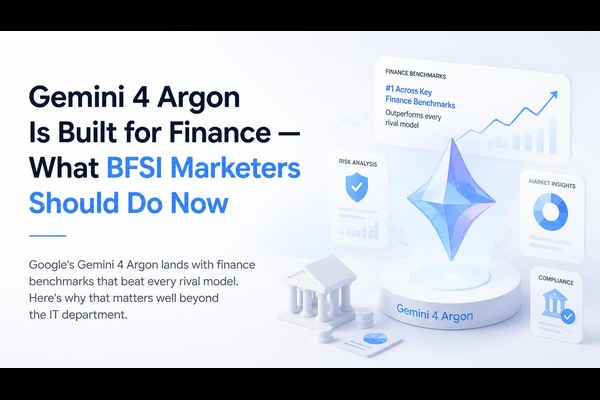
Argon was built for tasks that resist being broken into a neat sequence of short prompts: software migrations, multi-step financial research, legal drafting, cybersecurity remediation. Google explicitly targets "enterprise knowledge work like legal and finance" as a first-class use case, not something retrofitted after launch. On the Vals Finance Agent v2 benchmark — which measures multi-step financial research — Argon scores 65.4%, against 58.6% for Claude Opus 5.5 and 53.5% for GPT-6 Astra. On the broader Vals Index, which weights finance, coding, legal, and tax work by GDP contribution, it ranks first at 68.9%.
Independent testing from Artificial Analysis puts Argon's hallucination rate at 15%, compared to roughly 54% for GPT-6 Astra. In a sector where a single incorrect fact in a customer-facing document carries regulatory consequences, that number is genuinely material — not a footnote.
From Chatbot to Execution Layer — and Why the Distinction Matters to Marketers
Earlier Gemini models were pitched around answering questions faster. Argon's framing is different. Google's language is about sustaining deep reasoning across complex, long-horizon workflows without collapsing tasks into repeated short interactions. One benchmark makes the shift concrete: Argon scores 51.3% on Zapier's AutomationBench, which measures end-to-end execution across core business functions rather than single-turn answers. No other frontier model comes close at this writing.
For a bank or insurer's marketing operation, the practical implications stack up quickly. Pulling a product brief from five regulatory PDFs, cross-referencing customer segment data, drafting compliant copy variations, running internal checks — these steps have historically required a human analyst sitting between the AI output and the campaign, re-prompting at every handoff. Argon can hold all of that inside a single model trajectory. The model reads the deck, cross-checks the table, and produces output against a business system without waiting to be nudged forward.
That puts it in a genuinely different category from the tools most BFSI marketing teams have been piloting. A recent survey cited by MarketScale found that only 9% of bank and credit union marketing teams currently use AI agents for autonomous action. The gap between where the technology has arrived and where adoption actually sits is wide — and Argon makes that gap harder to justify sitting in.
The BFSI Marketing Workflows Worth Testing First
Access to Argon is still limited at the time of writing. Google is releasing it through the Fairwind Program to trusted cyber defenders first, with paid API customers and Google AI Ultra subscribers next, and no public date confirmed. That gives BFSI marketers a short window to prepare rather than scramble.
Compliance-aware content at scale. Financial products sit inside a web of disclosure requirements, product-specific regulatory language, and channel-specific restrictions. Current AI tools require heavy human editing precisely because they lack the context retention to hold all those constraints simultaneously. A 1-million-token output window changes the math. Argon can read a full regulatory document, a product brief, and a campaign brief in a single pass — producing copy that reflects all three, not just whichever prompt came last.
Multi-document research for campaign strategy. Insurance and wealth management campaigns typically start with weeks of analyst work — pulling competitor positioning, reading regulatory consultation papers, scanning quarterly earnings for messaging cues. An agentic model that can identify details from long documents, cross-reference them, and synthesize a strategic brief compresses that timeline significantly. Argon's multimodal capability extends this further: it scores 91.7% on Google's long video benchmark LVBench, which means earnings call recordings and video-format research — sources most financial marketing teams never have the capacity to process systematically — become genuinely usable inputs.
Hallucination Rates and the Compliance Question
BFSI is the vertical that asks the hardest question about any AI model: what happens when it's wrong? The 15% hallucination rate from Artificial Analysis is a relative advantage, full stop — it isn't a clearance to deploy without oversight. The difference is that a model with better factual accuracy and real context retention is wrong less often and, crucially, wrong in more predictable ways.
The practical implication for marketing operations is structural. Right now, BFSI marketing teams tend to insert human review at the moment AI output is generated, because the output is unreliable enough to need full re-reading every time. With a lower-hallucination, longer-context model, the review point can move downstream — checking outputs against a defined compliance rubric rather than rereading every word from scratch. That's a process redesign, and it compounds over time.
The Realistic Timeline for BFSI Teams
General availability is likely measured in weeks to a few months, not quarters. When it comes, the teams moving fastest won't be the ones who waited for full access before thinking through implementation. They'll be the ones who already mapped which workflows carry the most compliance risk, identified which data sources an agent would need, and decided where human-in-the-loop controls need to sit around any autonomous content generation.
On pricing: Argon launches at $2/$10 per million input/output tokens at the introductory rate, rising to $4/$20 thereafter. For enterprise-scale BFSI marketing campaigns, the cost arithmetic is simple — the labor displaced by a single well-designed agent workflow covers the API cost many times over.
The harder work is organizational. BFSI marketing teams that operate in siloed structures — where legal, compliance, and marketing rarely share a workflow — will struggle to capture Argon's value regardless of how capable the model is. The whole point of a long-context agentic model is holding legal constraints, product data, and marketing requirements simultaneously. Teams without integrated data access won't get there.
At Transformics, we've been architecting AI-augmented workflows for BFSI clients where compliance requirements are woven into the pipeline from the start — not patched in after the fact once something breaks. If your team is mapping where agentic AI fits into your marketing stack before general availability forces the conversation, we're already working through exactly that problem with clients in your space. Worth talking now rather than after the scramble starts.
Need help getting found by AI search?
Transformics helps brands future-proof their content strategy through AEO, structured data, and AI-friendly copywriting.
Talk to our team