Two major AI model launches, a structural change to how Google distributes ad budgets, and a Meta default that will affect every active campaign by October 28. The week of October 12–19 was dense. Here's what matters and what to do about it.
Meta's First Frontier Model: Muse Wonder Lands
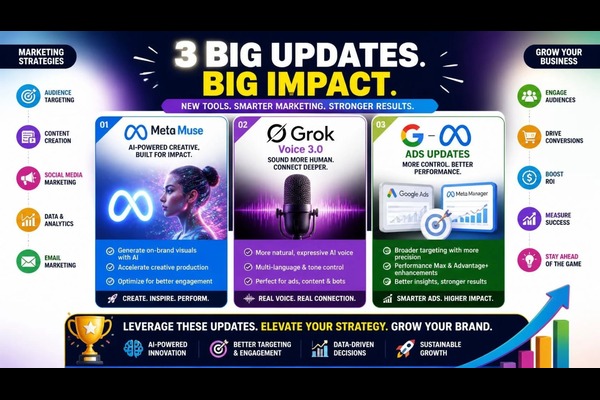
Meta Superintelligence Labs shipped Muse Wonder and Muse Wonder Full on October 12, marking the company's first genuine entry into frontier AI — a step above its earlier lightweight Muse Spark family. Both models are built explicitly for agentic tasks: long-running, multi-step work that unfolds over time rather than a single prompt-and-response. Meta's official description covers professional use cases ranging from navigating an insurance claim to parsing a lease to building a functional app from scratch.
The standout technical emphasis is what Meta calls "active memory" — the model's ability to retain and synthesize user information across days, weeks, and months. On MemoryBench, Meta's own testing shows Muse Wonder outscoring Fable, Opus, and Astra. Independent benchmarking from Artificial Analysis tells a more measured story: Muse Wonder lands at 52 on its Intelligence Index versus 56 for Muse Wonder Full and 58 for Opus 5.5 — competitive, but not dominant. Pricing through the Meta Model API sits at $4 per million input tokens and $20 per million output, roughly level with GPT-6 Sol and Opus 5.5. The stronger Muse Wonder Full stays locked inside Muse Code subscriptions.
The active memory angle has immediate relevance for financial services, insurance, and any sector running complex, multi-session customer interactions. A model that retains user context across conversations is structurally different from a chatbot that resets with every session. For developers building agent workflows right now, the API is live today — how fast Meta weaves it into consumer surfaces is the thing worth watching.
Grok Voice 3.0: The Voice AI Benchmark Just Got Reset
xAI released Grok Voice 3.0 on October 14, and the numbers are hard to ignore. Independent testing by Artificial Analysis puts it first on the Speech-to-Speech Index with a score of 86.9, ahead of OpenAI's GPT-Live-1 at 83.2 and Google's Gemini 3.8 Live at 82.6. On τ-Voice — the benchmark that tests robustness across accents, background noise, and interruptions, the real conditions of an actual call centre — Grok Voice 3.0 jumped from 56.5% on the previous version to 71.6%.
Pricing stayed at $0.08 per minute, unchanged from Grok Voice 2.0. Better model, same cost. xAI also reports sub-second response latency and a 40% latency reduction versus the prior generation. The architecture is speech-to-speech by design — audio in, audio out, no intermediate text hop — which is what keeps response times tight at scale. xAI says the model already handles millions of conversations daily across Tesla vehicles and Starlink customer support.
For brands running IVR, voice bots, or telecalling at volume — BFSI being the obvious example, where collections, policy renewals, and lead qualification all run on outbound voice — a step-change in model quality at the same per-minute cost is a direct operational lever. The EVA-Bench result from ServiceNow (74% accuracy on enterprise voice agent tasks) is more relevant here than the headline speech index. That number measures whether the model can actually resolve support calls, not just sound good. Combined with unchanged pricing, it makes the case for evaluation difficult to keep deferring.
Google Ads Gets Real Budget Controls — And a Shopping Overhaul
Two significant Google Ads changes landed in the same week. The bigger structural one: on October 14, Google announced Channel Prioritization and Budget Allocation, rolling out globally across Search, Shopping, Performance Max, and Demand Gen. The new system lets advertisers label each channel — Google Search, search partners, Display Network — as High or Low priority. Google's AI then funds high-priority channels first before allocating whatever remains to lower-priority inventory, with an optional percentage cap to stop lower-priority spend entirely.
The deadline matters. Search campaigns currently running with Display Expansion will migrate to this new system automatically in February 2027. That's four months to consciously decide your channel hierarchy rather than inherit whatever Google defaults to. Accounts spending across multiple networks without ever actively reviewing the split should treat this as an audit prompt — not something to revisit in Q1.
Separately, Google launched Universal Cart in the US on October 15: a cross-retailer shopping hub now live inside Google Search and the Gemini app. Shoppers can save products from multiple retailers into a single cart, receive price-drop and back-in-stock alerts, and check out via Google Pay or the merchant's own site. The cart runs on Google's Shopping Graph (60 billion-plus product listings) and Gemini models. For merchants and ecommerce advertisers, Merchant Center feed quality is now directly tied to whether products surface inside the cart at all. Clean feeds, active promotions, and accurate pricing data are the entry criteria for appearing in this new purchase-intent surface — and the holiday season is already here.
Meta Ads: Product Browsing Goes Default on October 28
Meta's advertising stack also shifted meaningfully this week. The change with the clearest hard deadline: on October 14, Meta announced it will auto-enable product browsing on all existing ads on October 28, 2026. When a user taps an ad, they may see an in-app browsing experience with product details and personalized suggestions before landing on the advertiser's website. Meta reported a 3% average conversion uplift in a 117,700-advertiser test — but the opt-in is automatic. Brands that want to exclude it need to act via Ads Manager or Advantage+ Creative settings before the 28th.
Beyond that deadline, the broader October theme across Meta Ads is AI expanding into creative and campaign execution. Static-image-to-video generation in Advantage+ Creative is now generally available. The AI business assistant in Ads Manager has been upgraded with campaign memory and is in limited testing for agentic actions — creating campaigns, adjusting targeting, changing budgets — all staged for human approval before going live. Customer Lifecycle Strategy, which lets advertisers ring-fence budget for new-customer acquisition separately from retention, opened to all advertisers on October 6.
Product browsing is the immediate action item. The AI agent testing is worth watching but not yet in wide release. If you manage clients or campaigns across Facebook and Instagram, October 28 is the operative date — check every active account before then, not after.
Taken together, this week drew a clearer line between AI as infrastructure (Muse Wonder and Grok Voice 3.0, built for work that runs over time or at call-centre scale) and AI as ad-platform automation (Google and Meta both pushing systems that make more decisions on advertisers' behalf). Those two tracks are converging fast. Transformics works across both — voice AI and IVR deployments in sectors like BFSI, and paid media management where the automation layer is already live. If you want to map either side for your business, the conversation is worth starting now.
Need help getting found by AI search?
Transformics helps brands future-proof their content strategy through AEO, structured data, and AI-friendly copywriting.
Talk to our team