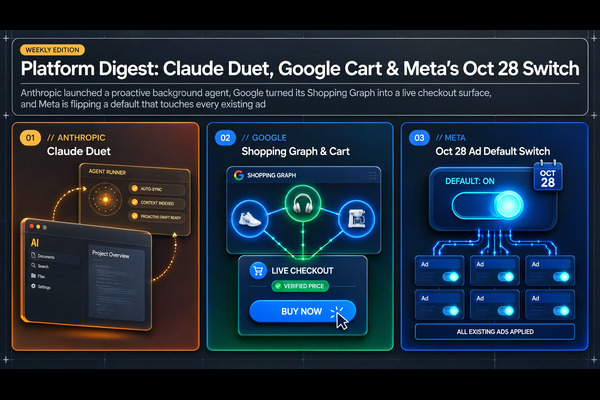
Three platforms made genuinely structural moves this week — one in AI agents, one in commerce infrastructure, and one a quiet default change that lands on every active Meta advertiser in two days. Here's what happened and what to do about it.
Anthropic's Claude Duet: The First Mainstream Ambient Agent
On October 21, Anthropic opened a research preview of Claude Duet — a new standalone app for iOS, Android, and claude.ai that turns Claude into a proactive agent rather than a reactive chat interface. The core shift: Duet monitors your connected apps, surfaces items needing attention, and keeps working after you close the app, running tasks on a cloud-hosted virtual machine with a built-in browser. It checks with you before acting on anything consequential — sending messages, making payments, signing documents.
Access opens by waitlist, starting with US Pro and Max subscribers. Anthropic is pitching it squarely at professionals and small business owners who manage more than they can actively track. Bigger jobs — building a financial model, assembling a dashboard from dozens of data sources — draw from the same usage limits as the regular Claude app, so heavy use will burn through allocations faster than most people expect.
For marketers, this is the clearest signal yet that the agent category has moved from demo to daily tool. A BFSI compliance team could, in principle, wire Duet to their email, CRM, and document repository and have it flag regulatory queries or draft client-facing summaries without anyone sitting at a prompt. That said, Duet is still in research preview — Anthropic openly acknowledges it can misjudge urgency or miss an update between check-ins. Get on the waitlist now. The teams that understand its limits earliest will be the ones who know how to use it well when it opens broadly.
Google Universal Cart: Checkout Has Moved Inside Search
On October 15, Google launched Universal Cart in the US across Google Search, AI Mode, and the Gemini app. Shoppers can now save products from multiple retailers into a single persistent cart, receive price-drop and back-in-stock alerts, see promo codes surfaced automatically, and check out via Google Pay — all without visiting a retailer's website. The cart draws on Google's Shopping Graph of 60+ billion product listings, updated continuously.
A week later, on October 22, Google added three new Customer Retention Modes across Shopping, Search, and Performance Max campaigns: Re-engagement Mode (targets buyers who lapsed in the last 91–365 days), Loyalty Mode, and a third retention-focused tier. Shopping campaigns join the customer lifecycle framework for the first time, which means Smart Bidding can now bid higher for specific CRM segments rather than treating every audience identically.
Two things worth acting on before Black Friday. If you run Shopping campaigns, your Merchant Center feed quality now directly determines whether your products appear in Universal Cart — price accuracy, stock status, and active promotions all feed the cart's data layer. A feed that hasn't been audited in six months is a real liability heading into BFCM. Separately, the new Retention Modes let you declare at campaign level whether you're trying to win back lapsed buyers or protect your existing customer base from competitors. Those are meaningfully different briefs. One bidding strategy shouldn't be doing both jobs.
Meta Product Browsing Goes Default for All Existing Ads — Tuesday
Starting October 28, Meta will automatically enable product browsing for every ad currently running on Facebook and Instagram, unless advertisers opt out before that date. When product browsing is on, a tap on an ad may open an in-app product page with item details and Meta-generated personalized suggestions — before the user ever reaches your website. Meta cited a 3% average conversion lift from an August test across roughly 117,700 advertisers as its justification for flipping the default.
The phrase "personalized suggestions" is where this gets complicated. Meta controls what appears on that in-app layer, and that can include competitor products alongside yours. For brands that have spent months refining a landing page funnel — particularly in sectors like insurance or financial products, where the journey from ad click to qualified lead is tightly choreographed — this is an extra variable they didn't choose to introduce.
The opt-out is simple: find the notice in Meta Business Suite and click the button before Tuesday, or toggle it off per ad in Advantage+ Creative and Destination settings. The harder question is whether to leave it on for catalog-heavy product lines and off for lead gen or service-based campaigns. Meta's 3% lift figure comes from a general retail test — it tells you nothing about your specific category or customer journey. Running lead generation for financial services? The opt-out decision is straightforward. Running ecommerce with a deep catalog? Test it on a smaller subset before BFCM rather than letting it run blind across the entire account.
The Week in One Line
AI agents went ambient, Google pulled checkout closer to search, and Meta handed itself more of the post-click experience — all in the same seven days. The common thread is reduced friction for the end user at the cost of reduced control for the advertiser. None of these are reversible at the platform level, so the real question for every marketing team is how deliberately they're choosing to engage with each change versus simply inheriting whatever the default happens to be. If you want a second pair of eyes on your Meta opt-out decisions or a fast feed audit before Tuesday, the Transformics team is already in the weeds on both with retail, financial services, and insurance clients this week — reach out and we'll make time.
Need help getting found by AI search?
Transformics helps brands future-proof their content strategy through AEO, structured data, and AI-friendly copywriting.
Talk to our team