The Report That Dropped This Week
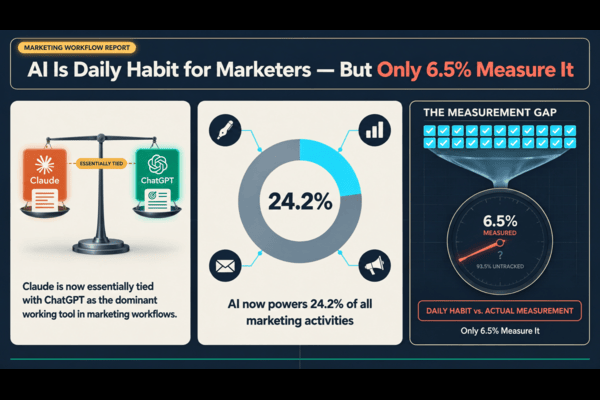
On October 19, Basis published the fourth annual edition of its "AI and the Future of Marketing" report — 184 marketing and advertising professionals across agencies, brands, and publishers surveyed in August 2026. The headline numbers are striking. Daily AI use nearly doubled year-over-year: 61.4% of respondents now use generative or agentic AI every single day, up from 33.6% just twelve months ago, and a long way from the 10.9% who said the same in 2023. Only 1.6% report not using AI at all.
Close to total saturation. The more consequential finding sits on the other side of that ledger.
Adoption Is Universal. Accountability Isn't.
Just 6.5% of marketing organizations evaluate their AI investments against defined metrics and benchmarks. Sixty-five percent either don't measure AI ROI at all, or genuinely don't know whether anyone at their organization is doing so.
Sit with that for a moment. Marketing has spent twenty years building infrastructure to track every rupee and dollar of paid media spend — attribution models, UTM parameters, multi-touch frameworks, brand lift studies. AI has become one of the fastest-growing line items in those same budgets. And the overwhelming majority of teams have no systematic way to say whether it's working.
Nor is this a small-team-with-limited-resources problem. Adobe's 2026 AI and Digital Trends report, drawing on 3,000 executives and practitioners globally, found only 44% have a measurement framework in place for generative AI. The Jasper State of AI in Marketing survey put the share of marketers who can actively prove AI ROI at 41%, actually down from 49% the year prior, even as adoption climbed sharply.
Adoption up, provability down. That's the real story here, and the direction of travel matters more than any single data point.
The Tool Shift Nobody Expected
One data point in the Basis report deserves its own paragraph. ChatGPT's share among surveyed marketers fell from 88.6% to 74.5%, while Anthropic's Claude surged from 17.9% to 72.3% in a single year. Claude is now essentially tied with ChatGPT as the dominant working tool in marketing workflows.
A market-share swing of that speed, inside twelve months, signals something more deliberate than trend-chasing. Marketers are discriminating — choosing tools based on performance for specific tasks rather than defaulting to whichever name is most famous. For any team that built internal templates, training, or workflows around one model, this is a practical prompt to revisit those assumptions. The landscape shifted while you were running campaigns.
Why Measurement Is Hard — and Why It's Becoming Urgent
There are honest structural reasons measurement lags adoption. AI productivity gains are often distributed across dozens of micro-tasks — a faster first draft here, a quicker data pull there, a smarter audience segment elsewhere. None of those moments shows up as a discrete line item in a campaign report. They diffuse into "we got more done," which is real value, but notoriously hard to price.
Agentic AI compounds the problem considerably. When an autonomous agent optimizes a bid strategy or rewrites ad copy mid-flight, its output is tangled with platform algorithm behavior, seasonal demand shifts, and creative quality. Isolating the agent's contribution requires pre-defined baselines, control conditions, and someone who cared enough to set them up before deployment — not after the fact, when the moment to measure has already passed.
The Basis data makes the stakes explicit: organizations with structured AI measurement are best positioned to scale what's working and cut what isn't. Without that scaffold, more AI spend largely means more noise at higher volume.
What This Means in Practice
A few concrete implications for marketing teams at any scale:
- Baseline before you build. Before deploying any AI tool or agent into a live workflow, document what the current state looks like — time-to-output, cost-per-unit, conversion rate, whatever is relevant. Without a pre-AI benchmark, you have no denominator for your ROI calculation.
- Separate efficiency gains from effectiveness gains. AI saving your team six hours a week is real value. AI improving your campaign conversion rate is a different kind of value entirely. Conflating them inflates the story you tell internally and obscures which applications actually deserve more investment.
- Audit your tool stack honestly. The Claude-versus-ChatGPT swing shows teams are actively switching. If you chose your AI tools 12 months ago and haven't tested alternatives since, the landscape has moved enough to warrant a fresh look — especially for high-volume tasks like ad copy and campaign reporting, where marginal quality differences compound at scale.
- Track AI-specific KPIs alongside campaign KPIs. Only 19% of teams currently measure AI-specific content performance metrics. Setting these up is straightforward: per-asset production cost, human edit rate on AI drafts, time from brief to publish. They don't replace campaign metrics — they sit alongside them and reveal whether the tool or the strategy deserves credit for the result.
The Wider Pattern
The Basis findings slot into a broader pattern visible across multiple 2026 surveys. The CMO Survey from Duke and Deloitte found AI now powers 24.2% of all marketing activities — nearly double the 13.1% figure from 2024 — with marketing leaders projecting that figure will reach 55.9% within three years. Adoption velocity is not slowing. The gap between organizations that capture that value and those that simply accumulate subscriptions is, increasingly, a measurement and governance gap rather than a technology one.
We work across paid media, content, lead generation, and marketing automation at Transformics, and the measurement question comes up in every AI conversation that goes anywhere useful. The teams pulling ahead tend to share one habit: they defined what winning looks like before they started — and they actually check it.
Need help getting found by AI search?
Transformics helps brands future-proof their content strategy through AEO, structured data, and AI-friendly copywriting.
Talk to our team